> For the complete documentation index, see [llms.txt](https://docs.supercmms.com/llms.txt). Markdown versions of documentation pages are available by appending `.md` to page URLs; this page is available as [Markdown](https://docs.supercmms.com/inventory.md).
# Inventory
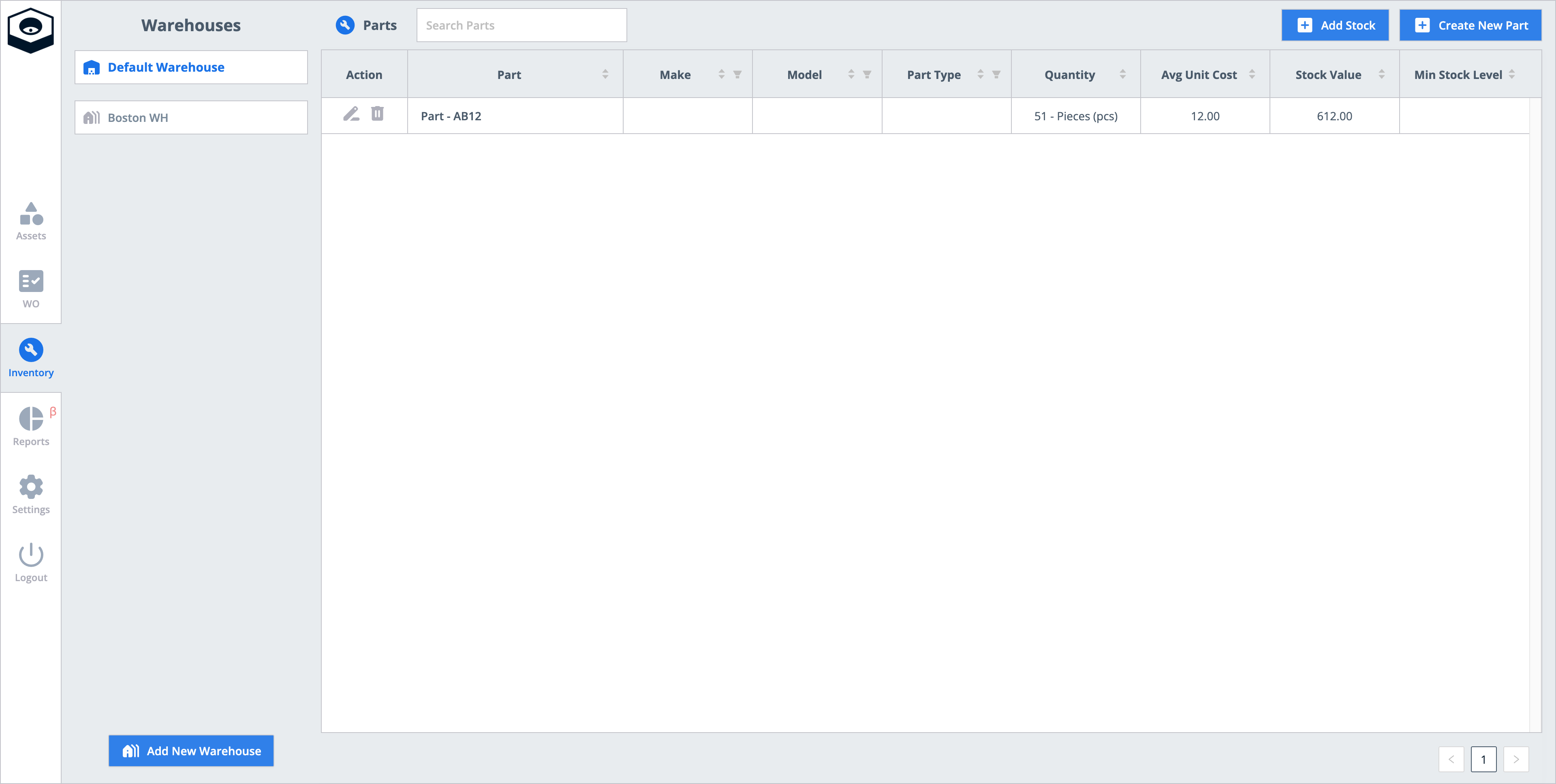
SuperCMMS comes with an easy to use and powerful '**Inventory Module**'. The Inventory Module has three key components.
1. Warehouses
2. Parts
3. Stock Register
### **1. Warehouses**
This is a physical location or building where you store all your **Parts**.
* A '**Default Warehouse**' is created for every account.
* You can add more Warehouse as required.
* Parts can be moved between Warehouses.
### 2. Parts
We define a '**Part**' as a replaceable unit of an Asset or Sub-Asset. In other words, a '**Part**' is any individual component, material, or item held in stock that is used in the production of goods or for maintenance and repair of equipment.
* You can add 'Parts' within Warehouses.
* For each part you can add details like descriptions, prices, quantities, manufacturer and vendor details, minimum stock levels, etc. You can also create 'custom fields' for part details.
* You can move 'Parts' between 'Warehouses'.
### 3. Stock Register
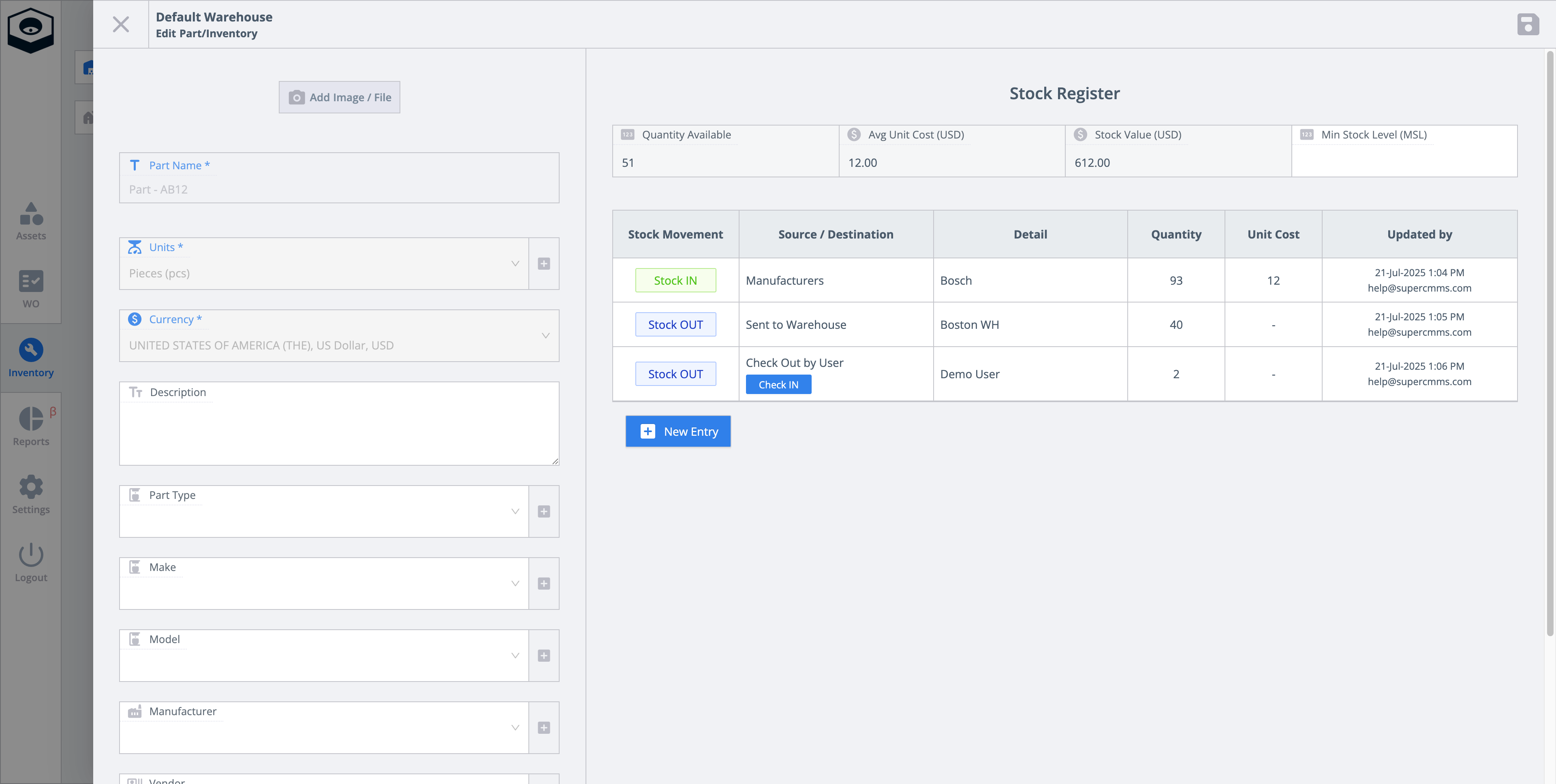
A 'Stock Register' is used to track all 'IN' and 'OUT' movements of 'Parts'. This helps you monitor and manage stock levels accurately for effective inventory management.
**You do a 'Stock IN' entry when ....**
* You purchase Parts from a Manufacturer or a Vendor.
* You receive Parts from another Warehouse.
* Parts are 'checked-in' by a User.
**You do a 'Stock OUT' entry when ....**
* Parts are consumed by a Work Order.
* Parts are 'checked-out' by a User.
* Parts are sent to another Warehouse.
All Stock-IN and Stock-OUT entries are accompanied by 'Quantity' and 'Cost' details. These help you keep track of 'Minimum Stock Levels' and 'Stock Value'.